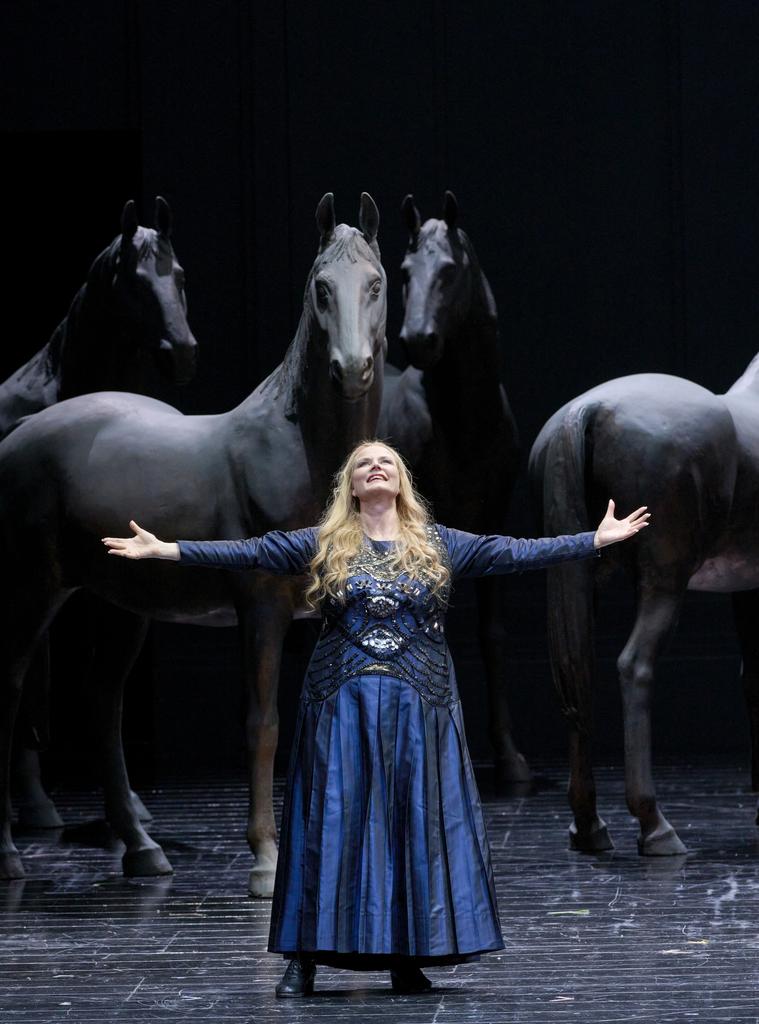
Developed between 2007 and 2009, the Vienna State Opera is now showing Richard Wagner’s tetralogy, THE RING OF THE NIBELUNGS, for the last time in the production by Sven-Eric Bechtolf. At the beginning of 2019, at least the direction of the performers and character guidance of the already aging production were refreshed, making these two elements appear a touch more like chamber theater and subtler, and fortunately, they still do. Wagner’s modernity in addressing socially pressing issues, which still makes the composer a visionary today, is not the focus of this staging: Bechtolf, in the way he tells the story, does not rely on specifically contemporary political or social interpretations; for him, the ‚RING‘ exists even without a ‚message.‘ Although aesthetically successful over long stretches, the call for a new Vienna ‚RING‘ gradually grew louder and louder, and by the 2027/28 season, it’s set to happen. Bechtolf’s direction should be credited with the fact that it served its purpose quietly for many years, but in a way that was extremely suitable for the repertoire. Let’s hope that the mostly solid staging won’t be replaced by spectacularly nonsensical directorial gimmicks.
The musical side of this last cycle in May 2026 – DAS RHEINGOLD on the 6th, DIE WALKÜRE on the 7th, SIEGFRIED on the 10th, and GÖTTERDÄMMERUNG on the 14th – is more than uneven. Sadly, the Orchestra of the Vienna State Opera didn’t show up in its usual form on any of the four evenings. Could it be that many of the young musicians in the ensemble had only a few or no rehearsals at all for this complex and demanding cycle? Or did they simply struggle to get on board with the transparent, sharply harsh sound preferred by the extremely versatile conductor Pablo Heras-Casado, and his approach marked by inconsistent tempo drama – often dragging with only occasional forward-driving momentum? Rarely do you hear so many wrong entrances from the horns and tubas, and rarely do the trumpets and trombones play so out of sync. The picture only shifts starting with the ‚Funeral March‘ on the third day: finally, you hear that big, full, rushing Wagner sound, where before it was only suggested through sometimes exaggerated volume.
As far as the cast is concerned, only a few of the summoned deliver consistently top-notch performances.
Above them all stands the magnificent Brünnhilde by Camilla Nylund, a singer of the highest vocal caliber, who brings genuine humanity to the role. On the first day, she gives the young Valkyrie femininity and warmth, following the tradition of great French predecessors like Germaine Lubin and Règine Crespin. On the second day, as the woman awakens, she adorns her with almost radiant rockets of her youthful-dramatic soprano. And in the demanding role of the betrayed avenger and world savior on the third day, she grows more and more into it: phenomenal, how the wonderful voice floats above the orchestra and already has the strength to move almost unharmed through the masses of the orchestra, an outstanding performance.
Michael Spyres impresses with his clear articulation, top-notch phrasing, and the beautiful warmth of his shining tenor: this robust, bright Siegmund also amazes with incredibly long-held “Wälse” calls.
Michael Volle as Wotan didn’t have his best day on the first night, and even the Wanderer on the second day only really succeeds in the third act. Moving, touching, with beautifully sung phrases, he nonetheless shapes Walküren-Wotan – it’s just simply gripping how the father of the gods and conqueror of storms takes leave of his beloved daughter, the maiden Brünnhilde, with a flowing voice.
Andreas Schager lifts the two Siegfrieds in his tried-and-true heroic tenor, stentorian style with long, sustained, taut, penetrating notes. Unfortunately, when it comes to the high notes, he doesn’t hit his usual form, strength, or confidence this time.
Georg Nigl shapes the Nibelung prince Alberich with inherently profoundly eerie expression; however, his role portrait, repeatedly slipping into a halted recitative style with strong acting, might not fully convince everyone in the audience. Szilvia Vörösz, as Fricka, confronts her god-husband as a strong adversary in WALKÜRE, and her warmly caring, full-voiced Waltraute in GÖTTERDÄMMERUNG is incredibly captivating. The young Jenni Hietala as Freia and Gutrune really makes people take notice.
Unfortunately, the rest of the assembled forces all lack that outstanding vocal level that is basically expected at a premiere venue like the Vienna State Opera, and which can also be expected given the high ticket prices. The audience at the Vienna State Opera, which is nothing new, still applauds the singers enthusiastically, and the conductor and orchestra are also included in the loud acclaim.