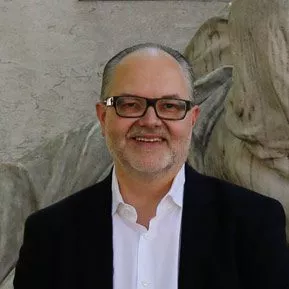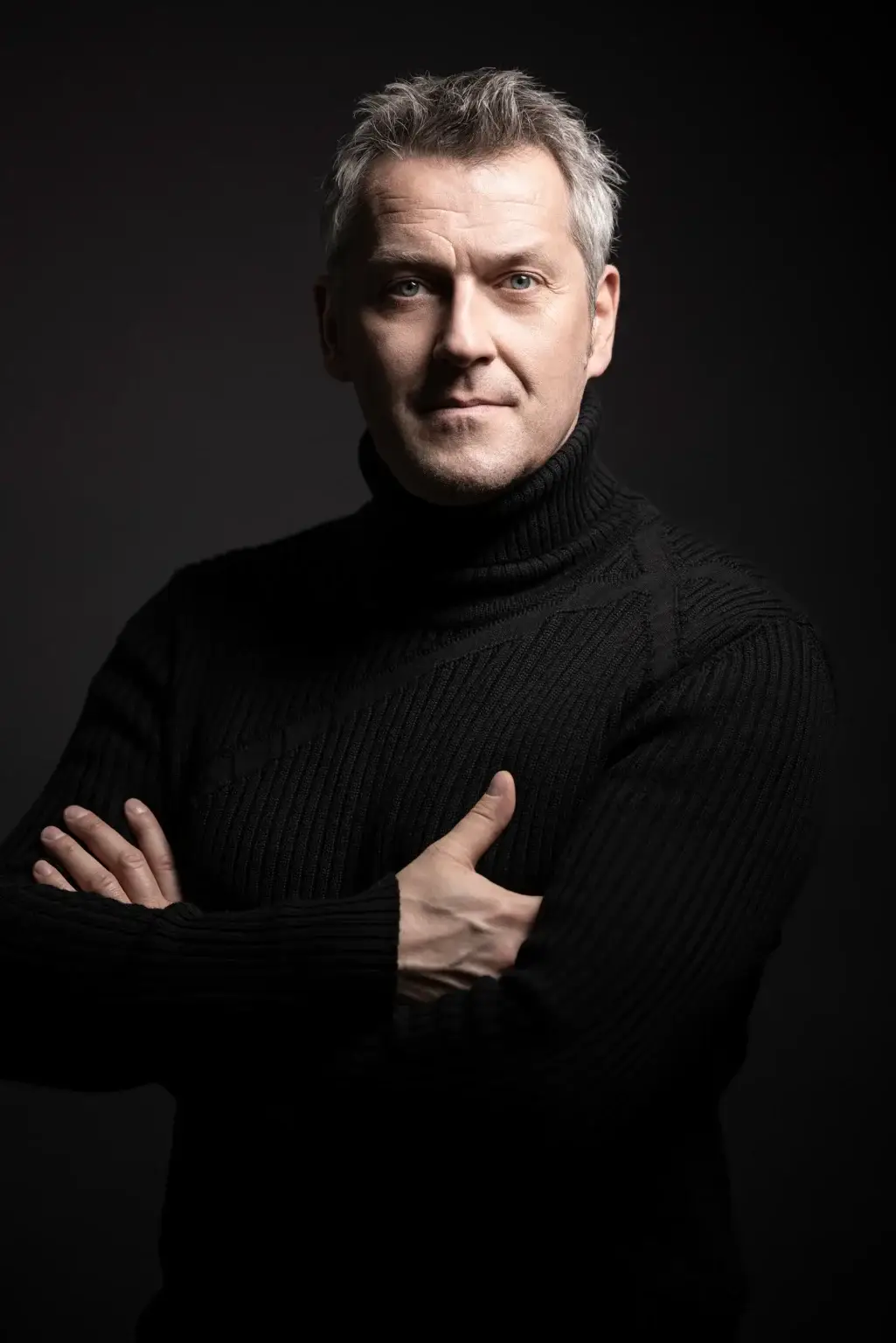
Markus Poschner, one of the most versatile and busiest conductors of our time (chief conductor of the Bruckner Orchestra Linz and general music director at the Musiktheater Linz until the end of 2026/27, as well as at the Sinfonieorchester Basel, designated chief conductor of the ORF Radio-Symphony Orchestra Vienna from 2026/27 and of the Utah Symphony Orchestra from 2027/28), gave an interview to SIMPLY CLASSIC in his office at the Musiktheater Linz.
Utah Symphony is a first-class orchestra; it is among the top ten in the American orchestral landscape, says Markus Poschner in response to the question of what motivates him to move from the Danube in Linz to the salt desert in Salt Lake City, Utah. But I am also moving to Vienna to the ORF RSO, which will then be my main place of residence, and then I also have my orchestra in Basel. America and the Utah Symphony have really inspired and challenged me: we all see where the country, the USA, is drifting, which is not, however, an American peculiarity, but something that can be observed all over the world – populism, radicalism, with absurd things, polarization, fragmented society. There are many reasons for this, but also many reasons to resist it, and with such a powerful cultural institution as an orchestra as a vehicle to reach people’s souls through music, it is possible to make an impact here. An American orchestra, which is organized differently than a European one, also helps me personally to progress. Three leadership positions certainly increase the need for organization, but here I have excellent support from my agencies.
Markus Poschner’s celebrated recordings of the Bruckner symphonies, released on the NAXOS label for Anton Bruckner’s 200th birthday in 2024, bring together all versions of all symphonies that are marked as significantly revised and altered in the authoritative New Anton Bruckner Complete Edition, and reflect the latest state of research and the most current editorial criteria. The conductor leads the Bruckner Orchestra Linz and the ORF Radio Symphony Orchestra Vienna.
Of course, I will also conduct Anton Bruckner in Utah, who is also highly appealing in America; people practically long for this experience. Utah is famous for its nature, for its incredibly vast national parks. Proximity to nature is part of the identity of the people there – and of course, Bruckner is immediately a name that comes up, because his music conveys such an expansive feeling. A great Bruckner symphony is like climbing a mountain peak; when you reach the top, the sun rises, overwhelming emotions are released that cannot be formulated or described in everyday language. This music cannot be comprehended with concepts either; whenever we try, we do not understand it; we only understand it when we are moved emotionally, not intellectually: only then are we with ourselves, which is equivalent to an archaic experience through art, when we establish a connection to find oneself.
In the music of Anton Bruckner, I pursue a deliberately bold, brisk approach to interpretation. My vision was multifaceted access. Bruckner is much more than the sublime and the spiritual; I wouldn’t even say sacred. The overwhelming nature of his music must always be present, just like the urgency and intimacy of this music. What are the roots of his music? A fantastically well-founded folk music as the only constant, which one would hardly believe, namely the slow, Upper Austrian, Bohemian-related polka. Alongside folk music, it was the Viennese Classicism, Mozart, Beethoven, especially Schubert, that influenced him. All of this, in turn, has a major impact on the tempo, the phrasing, the balance—in fact, on all musical parameters. His instructions also allowed my approach, as I was very meticulous; we did not violate any of his directions, which was the original impulse for my complete recording of all Bruckner symphonies in all existing versions. This emphasized dancer-like, folk-music character is still present even in the Scherzo of the Ninth Symphony. But there one can also already hear the mechanical, the grotesque, the social changes brought about by industrialization. And what should not be forgotten in this context: Gustav Mahler was a student of Bruckner, then premiered his Sixth Symphony, and carries on the grotesque, the parody, the caricature, the collage, which are also present in Bruckner’s music, to the fullest extent. Likewise, Bruckner’s late music possesses the dreamlike, through which one can only recognize the true, and the surreal, which by that time at the end of the 19th century had already begun to spread widely. I consciously did not record a completed version of the finale of the Ninth Symphony, which survives only in fragments, although there are fascinating, successful attempts, for example by the recently deceased Benjamin-Gunnar Cohrs. Bruckner also releases us into nothingness with the ending of the Adagio of the Ninth Symphony – just as Franz Schubert did before, with whom he shares so much, with his Seventh Symphony, the “Unfinished.” This ending of the Adagio does something to us: a feasible path for me is to play his “Te Deum” before the – perfectly unfinished – Ninth, or “Lontano” by György Ligeti, or “L’Ascension” by Olivier Messiaen.
Role models who have shaped me were the conductors Sir Roger Norrington and Sir Colin Davis, who, after my studies, were important sources of inspiration and could hardly have been more opposite: one can hardly imagine this enormous range between the two. On the other hand, the two meet in a very peculiar way, because both personalities were incredible ‚intuitive musicians‘ with an infallible intuition. With Norrington, basically a scientist with heart and mind, I assisted in all Beethoven symphonies; for him, unconditional ’non vibrato‘ was a dogma. With Davis, I assisted with the three Da Ponte operas and Mozart’s „The Magic Flute“; he did things quite differently, but incredibly consistently, a Mozart who is delicately assertive, equally convincing, he was completely at home with himself. With Davis, I experienced great, moving evenings like hardly anyone else before, although I could never have copied him, because his style would have matched neither my tempi nor my approach.
I have really discovered Leoš Janáček for myself now. Occasionally I have conducted the ‚Sinfonietta,‘ but never opera repertoire. Last year I conducted ‚The Cunning Little Vixen‘ here at the Linz Music Theatre, now ‚Katja Kabanova.‘ Janáček is a completely unique planet, reflecting the time after the First World War, reaching incredible form and grandeur in the 1920s, and all of this in his Brno in Moravia, in his home, in nature. Nightmare-like, Kafkaesque moments, working with the rhythm and melody of speech, in his music the processual dominates. Slavic music with immense melancholy, no arias, with completely dissolved structure, the structure develops horizontally instead of vertically, there is no longer any division, immensely direct, leading into the basement of the soul’s abysses. For these works, although they are not long, one needs time; one cannot consume them en passant. These are highly complex works that one must often listen to to understand their depth, and even to be able to explore them at all. The protagonist in ‚Katja Kabanova,‘ for example, is a very strong woman who fails because of her own societal drive, unable to assert herself against her own upbringing and society’s expectations of her. And then a subtle storm breaks over her – that is incredibly powerful. The polyrhythms and polytonality of Janáček’s music are also very difficult for the orchestra, an immense challenge, torn-apart harmonies, with lyrical moments of calm in between, where everything sinks, completely at peace with itself: Janáček’s incredible cosmos of eruptions and emotions offers us a delta of possibilities to find our own approach.
Introducing young people today to classical music, getting them excited about it? Through access, through closeness, we must cleverly and flexibly remove the barriers for them in every respect. Everyone is trying very hard today to get young people to attend concerts, and it is very much about the way and the format of the offering. The traditional concert in its form is certainly great and works, but we have to be more diverse, more imaginative, and build in intermediate stages. We need to make it clear that music is not just entertainment but can also change one’s own life; with music, the fundamental ground of our being is reflected, in these works of art I can see myself, we have to convey that I can change, understand, and recognize myself. Music has something to do with our lives and is not just a surface that only distracts me. The mysterious, the power of masterpieces from different centuries is always linked to a great closeness to our lives: in doing so, our existence is negotiated, our innermost feelings in the individual – longing, love, disappointment, hatred – are questioned. Two things you have to bring with you: time and open ears. Music is not a secret science, you also don’t have to be able to read music, you just have to engage with it and maybe even a second or third time. We musicians can help open this window. My offer is – I can unlock the door for you: whether, when, and how you go through it, you have to know yourself. Our primary responsibility is to hand this key directly to the younger generation. I do not share this cultural pessimism that there is no interest. On the contrary, I have had experiences, encountered a lot of openness, even teenagers who eagerly and passionately engage with contemporary music. The music of Mahler, Beethoven, Bach, Boulez, for example, will never lose its power. One must approach young people with music and meet them halfway, not just present something to them.
„Music is a sacred art‘? Yes – in any case in the sense of the invisible, the mysterious, the unspeakable. We are not what we see, think, and know, not a product of our intellect, but above all, we are what we feel; that is our identity. We need to investigate our own inner selves, and music can help us a lot in doing so. We need the other, the community, affirmation, love, warmth, affection – and the language of this world is music, which goes directly to the heart without detouring through the intellect. Hearing is a sense that cannot be closed off; it is directly connected to our inner being. In this respect, the sacred is that which is worthy of protection and therefore a very important aspect of our identity. One might only have to phrase Hofmannsthal’s statement slightly differently today, because, in my opinion, the word ’sacred‘ should be thought of holistically.