‚Musicians must feel comfortable: They need a hand that strikes clearly.‘
‚I believe that music is much stronger than people themselves believe. I do not know if it creates general peace: But in any case, it creates inner calm. And that is lacking for many people, yes, I would say, parts of the world. These are my experiences that I have with music.‘
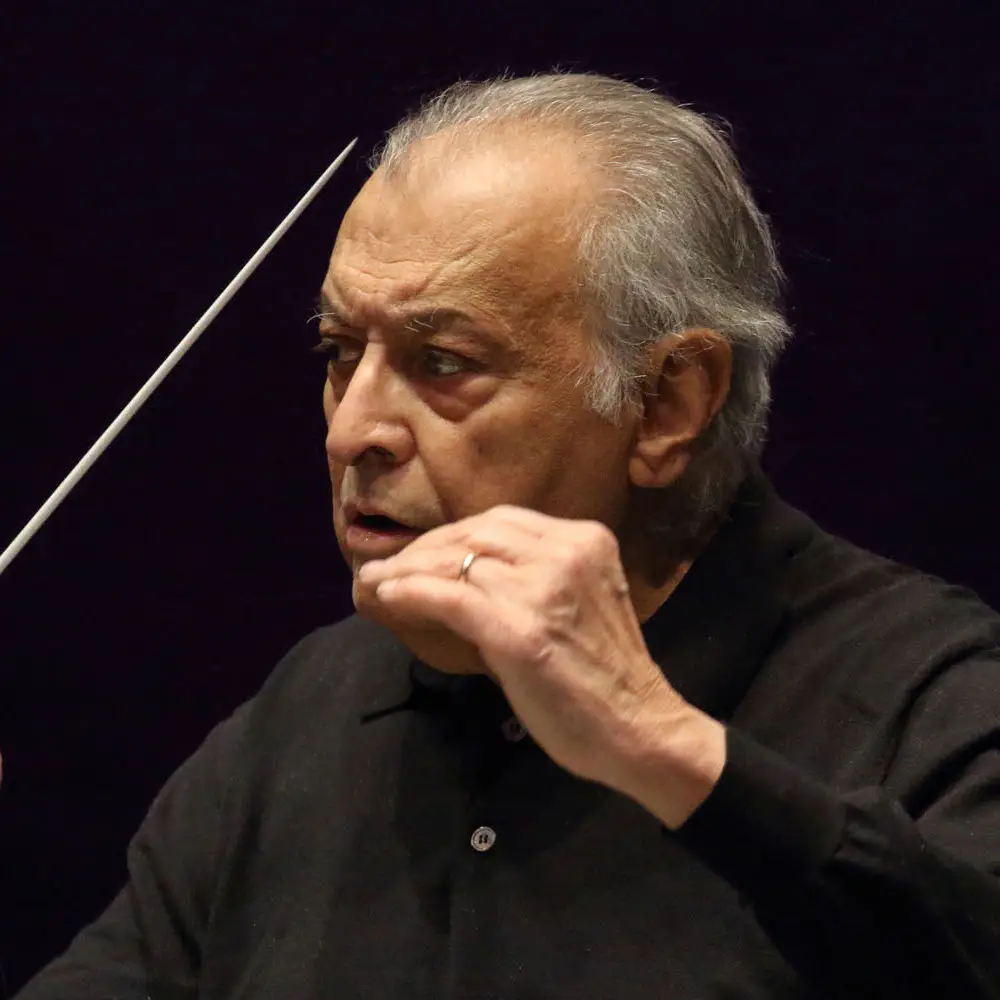
When he came to Vienna at the age of 18, he was immediately everyone’s favorite, attractive, incredibly charming, which he remained his whole life, and from 1954 studied conducting with the legendary Professor Hans Swarowsky. Later, when he was already one of the most fascinating podium stars on the international music scene and married to the American film and theater actress Nancy Kovack, he said that because of his love for Viennese musical culture, he had become a „Viennese born in India by chance.“ Once, when asked whether he took vacations given his enormous workload of conducting, he is said to have replied in essence that he did not need a vacation; for relaxation and recuperation, he only needed to conduct the third movement, the Adagio, from Anton Bruckner’s Symphony No. VIII. At 84, diagnosed with cancer, he did not let it get him down: „Music gave me strength.“ Recovered, he defies the body and still conducts with extraordinarily alert, radiant eyes.
He was born on April 29, 1936, in Mumbai, formerly Bombay, into a renowned musical family. As early as 1958, he won the „Liverpool International Conducting Competition“ and was also a prize winner at the Tanglewood Summer Academy. By 1961, he had conducted the Vienna Philharmonic and the Berlin Philharmonic as well as the Israel Philharmonic Orchestra; he remains connected to all three orchestras to this day: he is probably most familiar with the Vienna Philharmonic, whose New Year’s Concert he has conducted five times – in 1990, 1995, 1998, 2007, and 2015 – and indeed, he has conducted this orchestra around 400 times over more than 65 years.
From 1961 to 1967, he held the artistic direction of the Montreal Symphony Orchestra, and from 1962 to 1978, he was the artistic director of the Los Angeles Symphony Orchestra. This was followed by engagements with the New York Philharmonic Orchestra (chief conductor from 1978 to 1991), where he was the longest-serving chief conductor, succeeding Pierre Boulez. His work with the Israel Philharmonic Orchestra (advisor since 1968, chief conductor from 1977 to 2019, since 2019 Conductor Emeritus), with which he toured on all five continents, was crowned in 1994 with a tour to his native country India. From 1985 to 2017, he was the chief conductor of the opera festival „Maggio Musicale Fiorentino“ in Florence. Between 1998 and 2006, he was Bavarian General Music Director and thus musical director of the Bavarian State Opera.
Since his debut in 1964 in Montreal, he has also conducted operas at the Metropolitan Opera in New York, the Vienna State Opera, the Royal Opera House Covent Garden in London, La Scala in Milan, the Berlin State Opera Unter den Linden, in Chicago, as well as at the Salzburg Festival. In 2006, he opened the Palau de les Arts Reina Sofia in Valencia, where he also conducted Richard Wagner’s ‚The Ring of the Nibelung‘ – he also conducted the tetralogy in Munich and Chicago – and in 2008 he conducted the opening performance of the new opera house in Oslo.
He wears the ‚Nikisch Ring‘, which was passed down to him by Karl Böhm. In 1997, he was appointed an honorary member of the Vienna State Opera. In 1999, he received the United Nations Prize for Peace and Tolerance. In 2001, he was awarded honorary membership of the Vienna Philharmonic. Numerous orchestras granted him the title of honorary conductor, such as the Philharmonics in Berlin, Munich, Los Angeles, and Israel, as well as the Staatskapelle Berlin. The Bavarian State Orchestra honored him upon his retirement as General Music Director in 2006 with the same title; in addition, he was appointed an honorary member of the Bavarian State Opera. He is also an honorary citizen of the cities of Florence and Tel Aviv. In 2022, the new concert hall at the Teatro del Maggio in Florence was named after him.
On the finals of the Football World Championships in Rome in 1990 and Los Angeles in 1994, he conducted the concert of the „Three Tenors“ with José Carreras, Plácido Domingo, and Luciano Pavarotti each time, which made him known worldwide even outside the classical music world. Promoting young talent worldwide is very close to his heart.
Together with his brother Zarin, he founded the Mehli Mehta Music Foundation in Bombay. He is also a co-founder of the Buchmann-Mehta School of Music in Tel Aviv, whose activities he is still involved in and of which he is honorary president. Regarding conducting alone, the star conductor and podium virtuoso was always an absolute exceptional talent, with a brilliant baton technique and a pronounced sense of style. In the last thirty years, he has also matured into one of the very great, profound, and genuine interpreters of the highest quality.
The music was always the main thing. This was also the case at an impressive premiere of Giuseppe Verdi’s „Otello“ on May 10, 1987, at the Vienna State Opera, with Plácido Domingo in the title role, where he emphasized the particularly characteristic light-dark contrast of the music in this opera and thus revealed the glaring contrasts of this painting of the soul.
I also particularly like to remember musically perfect, because balanced, performances of Richard Wagner’s drama in three acts, „Tristan and Isolde“ on November 19, 2005, and on July 8, 2006, at the Bavarian State Opera: always conducted with controlled authority, never too light or too heavy, with feeling and passion, both lyrical and dramatic, pausing and rushing forward.
At the Salzburg Festival, on July 29, 2013, when Giuseppe Verdi’s „Falstaff“ premiered, the tragicomedy about life, love, and death that this late work represents was revealed only in the pit, where a mature, age-wise interpretation, pointedly powerful as well as subtly tender, succeeded in the hands of the conductor of the Vienna Philharmonic.
At the Berlin State Opera Unter den Linden, at the premiere of Richard Strauss’s comedy for music, „Der Rosenkavalier,“ a musically simply magnificent evening became an outright triumph for the conductor. Rarely had one heard such a wistful „Rosenkavalier,“ entirely bathed in autumnal, indulgent colors. The master conductor even achieved the square of the circle he conjured the most wonderfully Viennese sounds from the Prussian State Orchestra.
At the Vienna Konzerthaus, on January 16, 2025, once again with the Vienna Philharmonic, he captured the characteristic individuality of Anton Bruckner’s Symphony No. 9 in D minor, WAB 109, in all its depth and shaped the magnificent work with the formation excellently positioned in all sections, in a compact, confident, and fulfilled manner. The great climaxes were built up thoroughly organically, the erratic blocks literally flowed into one another, and even the fact that Bruckner with this work and its bold harmonics had already widely opened the door to the music of the 20th century was brought out almost unmistakably. And the Adagio, the third movement, this conductor truly captured as Bruckner’s ‚farewell to life‘ in all its expressive power.
The extraordinary artistic and human greatness and humility he possessed is evidenced by the following exceptional experience: On May 14, 1995, at the Musikverein in Vienna, Anton Bruckner’s Fourth Symphony was scheduled, performed by the Munich Philharmonic under Sergiu Celibidache. At short notice, he had to take over the conducting from Celibidache, who had fallen ill. After the brilliant performance, the conductor indicated to the audience to hold back their applause and essentially explained with full humility that it was not he who had conducted the concert, but that Celibidache had guided him in thought from his sickbed. Much of Celibidache’s approach to interpretation and his philosophical world regarding Bruckner later flowed into his own interpretations of the truly Austrian symphonist.
Referring to his extensive discography, I may pick out a few recommendations that underline the conductor’s enormous versatility. The CDs should, even if partially out of print, at least still be available from antiquarian sources.
In a limited edition from the SONY label, his Brahms recordings that were made for CBS and RCA are compiled, with the New York Philharmonic and great soloists: all the symphonies, the Haydn Variations, the two piano concertos with Daniel Barenboim, the violin concerto with Isaac Stern, and the double concerto for violin and cello with Pinchas Zukerman and Lynn Harrell.
Under his direction, a centennial recording of Giacomo Puccini’s „Turandot“ was produced at DECCA with an outstanding cast featuring exceptional voices such as Joan Sutherland, Luciano Pavarotti, Montserrat Caballé, Nicolai Ghiaurov, Tom Krause, and Peter Pears, the John Alldis Choir, and the London Philharmonic Orchestra.
On his 85th birthday, a very special recording was released by the Munich Philharmonic with Joseph Haydn’s oratorio „The Creation,“ which audibly demonstrates the decades-long, deep connection between the orchestra and its conductor laureate. With Mojca Erdmann, Dmitry Korchak, René Pape, Andreas Herrmann, and the Munich Philharmonic Choir.
A passionately wild, strongly conducted interpretation of Gustav Mahler’s Symphony No. 2 in C minor was created for DECCA, with the Vienna Philharmonic, the Vienna State Opera Chorus, as well as the vocal soloists Christa Ludwig and Ileana Cotrubas.
Also recommended is a recording of Igor Stravinsky’s „The Rite of Spring“ released by TELDEC with the New York Philharmonic Orchestra: the spring ritual is interpreted here as archaically powerful, sharply intense, with volcanic-like orchestral eruptions.
Those who like heavy, darkly glowing, large voices in Giuseppe Verdi should be recommended an exciting complete recording of Giuseppe Verdi’s „Aida“ by EMI. Under a fiery, intense conducting, the tremendous, colossal voices of, among others, Birgit Nilsson, Grace Bumbry, and Franco Corelli sing, with the Orchestra and Chorus of the Teatro dell’Opera di Roma also engaged.
In the sound language of Richard Wagner’s „Die Walküre,“ the unique sound of the Bavarian State Orchestra and its energetic, tension-filled, and highly emotional conducting merge into an interpretation that spans a bridge between the great conductings of earlier decades and today’s modern Wagner style. A live recording of the Munich Opera Festival 2002 in the best sound quality, with a world-class cast – Waltraud Meier, Gabriele Schnaut, Mihoko Fujimura, Peter Seiffert, John Tomlinson, and Kurt Rydl, Label FARAO.
On April 29, 2026, Zubin Mehta celebrated his 90th birthday. Congratulations!