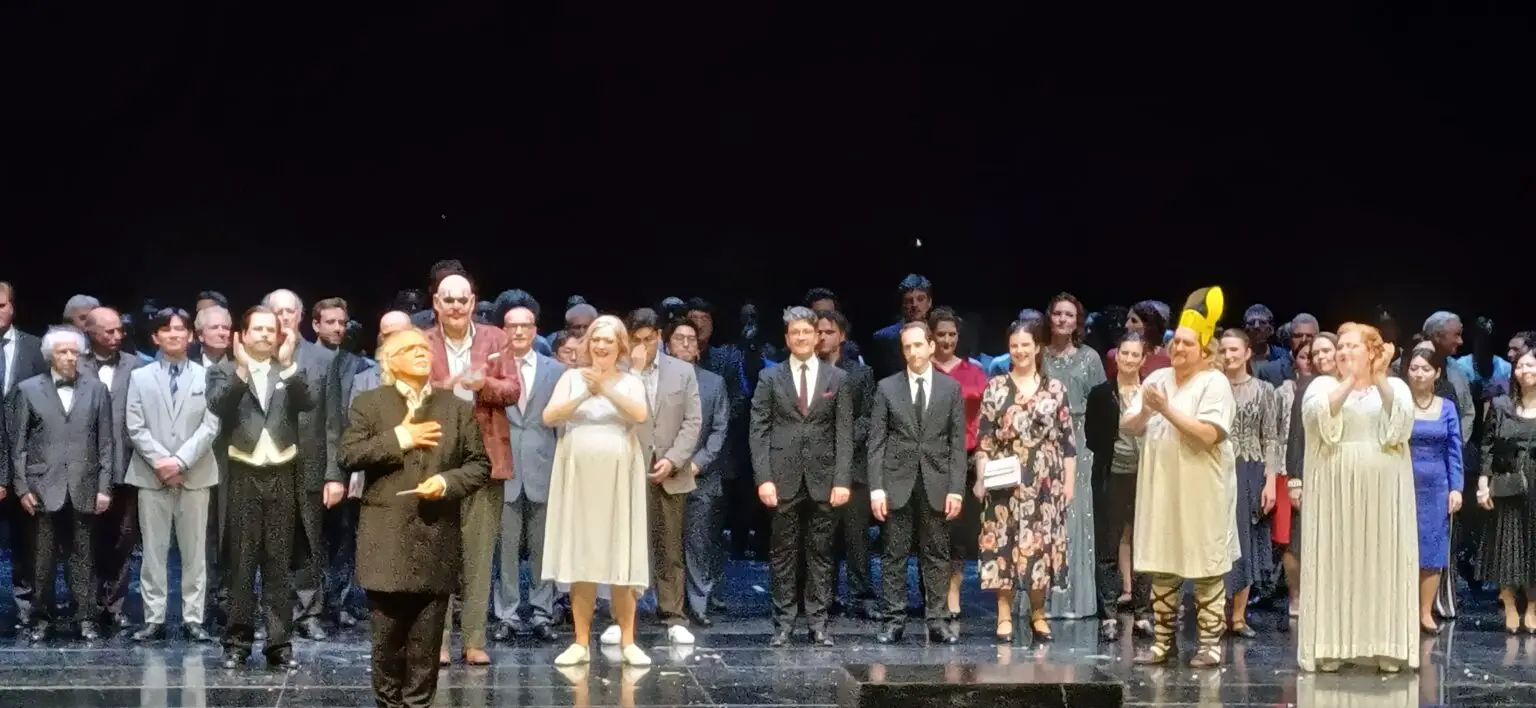
After almost seventeen years as General Music Director at the Deutsche Oper Berlin, with a total of thirty-five premieres and more than five hundred conducted performances, Sir Donald Runnicles now bids farewell with the greatest stage work of all, the monumental tetralogy THE RING OF THE NIBELUNG by Richard Wagner. The Scottish conductor at the podium does not overwhelm with a massive sound like Thielemann, does not rely on transparent speed like Welser-Möst, or on lucid brilliance like Petrenko – one must first get used to his creamy tempos and his specific sound. But soon one notices that this Wagner conducting is characterized by incredible, utmost internal tension, and the depths of the tetralogy, like every scene, are virtually illuminated and captured with intensity. The orchestral sections are performed exceptionally well, where Runnicles brings in and savors the full experience of his conducting life. The Orchester der Deutschen Oper Berlin follows him willingly and with great motivation through the four evenings. Highlights are – after a meditative preliminary evening with DAS RHEINGOLD on May 26, 2026, and a very solemn first day with DIE WALKÜRE on May 27, 2026 – certainly the second day, an already orchestrally accelerated SIEGFRIED on May 29, 2026, but above all the final third day of the stage festival play, a GÖTTERDÄMMERUNG characterized by the darkest blackness on May 31, 2026, where Runnicles’ compact, tension-filled, bursting sound, like a single immense stream, is simply intoxicating. After this impressively powerful performance, there is still an onstage tribute including a shower of stars for the departing chief conductor; he will be missed but fortunately will remain connected to the house as a guest.
From 1984 to 2017, the legendary “Tunnel” Ring was staged at the Deutsche Oper Berlin in the production by Götz Friedrich, one of the most important Wagner directors ever, with stage design by Peter Sykora. And one of today’s most sought-after opera directors and recipient of numerous international awards, Stefan Herheim, who studied opera directing in Hamburg under Friedrich from 1994 to 1999, has been a professor at the Norwegian Opera Academy since 2018 and, since the 2022/23 season, has served as general director at the Theater an der Wien, honored his great teacher with his own production of the tetralogy, which was once again performed in two cycles at the house on Bismarckstraße at the end of May 2026.
Herheim finds his own, highly interesting, and overall, convincingly coherent approach, with which he takes the audience on a journey to Wagner’s stage festival. His imagery-rich production is entirely developed from Wagner’s text and music; the direction of the characters and the guidance of the performers are precise, excellent, subtle, and psychologically well-founded, with the relationships between the characters clearly elaborated. With a few exceptions, Herheim also avoids anything overly elaborate that could overwhelm the audience.
Wagner’s world drama about the existential opposites of power and love unfolds as a play among refugees who no longer have a homeland and now seek their home in myth, which is why the stage design created by Herheim and Silke Bauer is also predominantly dominated by constructions made of suitcases. At the center of the stage design is a grand piano, where these people resting during their flight begin a game that develops independently as the tetralogy progresses. A white silk handkerchief grows larger and larger, becomes a leitmotif itself, and repeatedly creates spectacular effects: the Rhine and the mountains are suggested with it, as well as a rainbow and the world ash tree; naturally, it is also present as a shroud for Siegmund in the announcement of death and for the murdered hero Siegfried. In combination with videos by Torge Moller, William Duke, and Dan Trenchard, one sees great cinema, at times experiencing pure, color-saturated theatrical magic. And Herheim, who comes from puppetry, also mixes a considerable amount of comedy and irony into his production where appropriate, for example in the design of the characters of the Valkyries, including Brünnhilde on the first day, as well as Siegfried. Uta Heiseke is responsible for convincing and fitting costumes in the result.
Herheim’s fantastic Ring worlds, bathed in magical, plastically glowing light by Ulrich Niepel, captivate more from scene to scene. After the radiant entry of the gods into Valhalla at the end of the previous evening, the first day begins with petrification, and the events of the first day, shown in all their tragic clarity, gradually go downhill. On the second day, Herheim hits the balance between the comic and heroic-tragic elements with pinpoint accuracy, rarely seen in a director. On the third day, there are many surprising gameplay situations to experience, culminating in letting the world sink faithfully to work. At the very end, once again, there is the empty stage with the piano, a cleaner removes the last remnants, and the world play can begin anew. Many images from this interpretation, which makes a significant contribution to modern Wagner direction, remain in memory; to fully grasp them in their density, a few more viewings are recommended, and the director and his dramaturgs – Alexander Meier-Dörzenbach and Jörg Königsdorf – probably want to achieve exactly that.
As far as the cast is concerned, there is mostly light at the Deutsche Oper Berlin, although unfortunately sometimes there is a little shadow as well. In RHEINGOLD, Iain Paterson as Wotan cannot really convince vocally with his Wotan – placed in a uniform mezzo-forte – the higher-lying Wanderer in SIEGFRIED suits the singer more, here he has his best moments, especially in the scene with Erda, sung in a flowing baritone. Jordan Shanahan, called in instead of the all-too-early deceased Thomas Johannes Mayer, certainly has a rather noble expression as the father of the gods in DIE WALKÜRE, but unfortunately his voice is still a little too small for the large house; dignity and sublimity in the farewell to his desired maiden remain all too far on the track.
Otherwise, there are predominantly excellent voices to be heard. Addressing each one individually would go beyond the scope of a blog post, but it should be emphasized that even the smaller roles – Rhine daughters, Freia, Froh, Valkyries, Forest Bird with a soloist from the Boys‘ Choir of the Dortmund Choral Academy, Norns – are very well cast. Thomas Blondelle manages to captivate with a smooth, bright, perfectly focused tenor and extremely agile, deft performance; Michael Sumuel is a characterful Alberich; Thomas Lehman is always present as Donner and Gunther; Ya-Chung Huang is a playful, tenorially cunning and treacherous Mime; Annika Schlicht is a magnificent, dominantly strong Fricka as well as a warmly caring Waltraute; Lauren Decker provides a rich Erda situated in the deepest alto ranges; Felicia Moore is a more than role-covering Gutrune. Outstanding are the basses: Tobias Kehrer gives a very strong Fafner and a menacing Hunding; Albert Pesendorfer can move with his powerful bass as Fasolt, but above all he creates a profoundly abysmally evil, enormously powerful Hagen driven by tenacious hatred.
The role of Brünnhilde is, according to the different vocal characters, divided among three singers. Trine Moller is a youthful, gentle WALKÜRE, who is touching, but the powerful phonation in the Hojotoho cries is still missing. Elisabeth Teige endows Brünnhilde in SIEGFRIED with a magnificent jubilant tone – the singer delights, alongside Matthew Newlin’s robust, strong, metallically gleaming Siegmund, also as the passionately radiant Sieglinde. Catherine Foster in GÖTTERDÄMMERUNG is a true high-dramatic soprano, who can cut through the orchestral masses with an immensely strong middle range, including full, rounded high notes.
The best vocal performance of the attended second cycle is unquestionably to be attributed to Clay Hilley as Siegfried. One hasn’t heard this role performed with such distinction and clear articulation for a long time. In addition, he sings both roles, demanding to the utmost, with his heroic tenor brimming with power, stentorian yet always flexibly supple. The audience’s applause after the long third day for him, as well as for Catherine Foster and the conductor, rightly reaches stormy proportions.