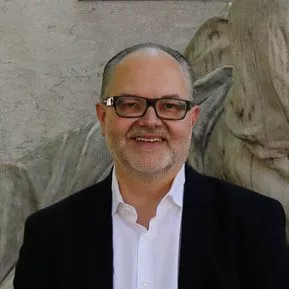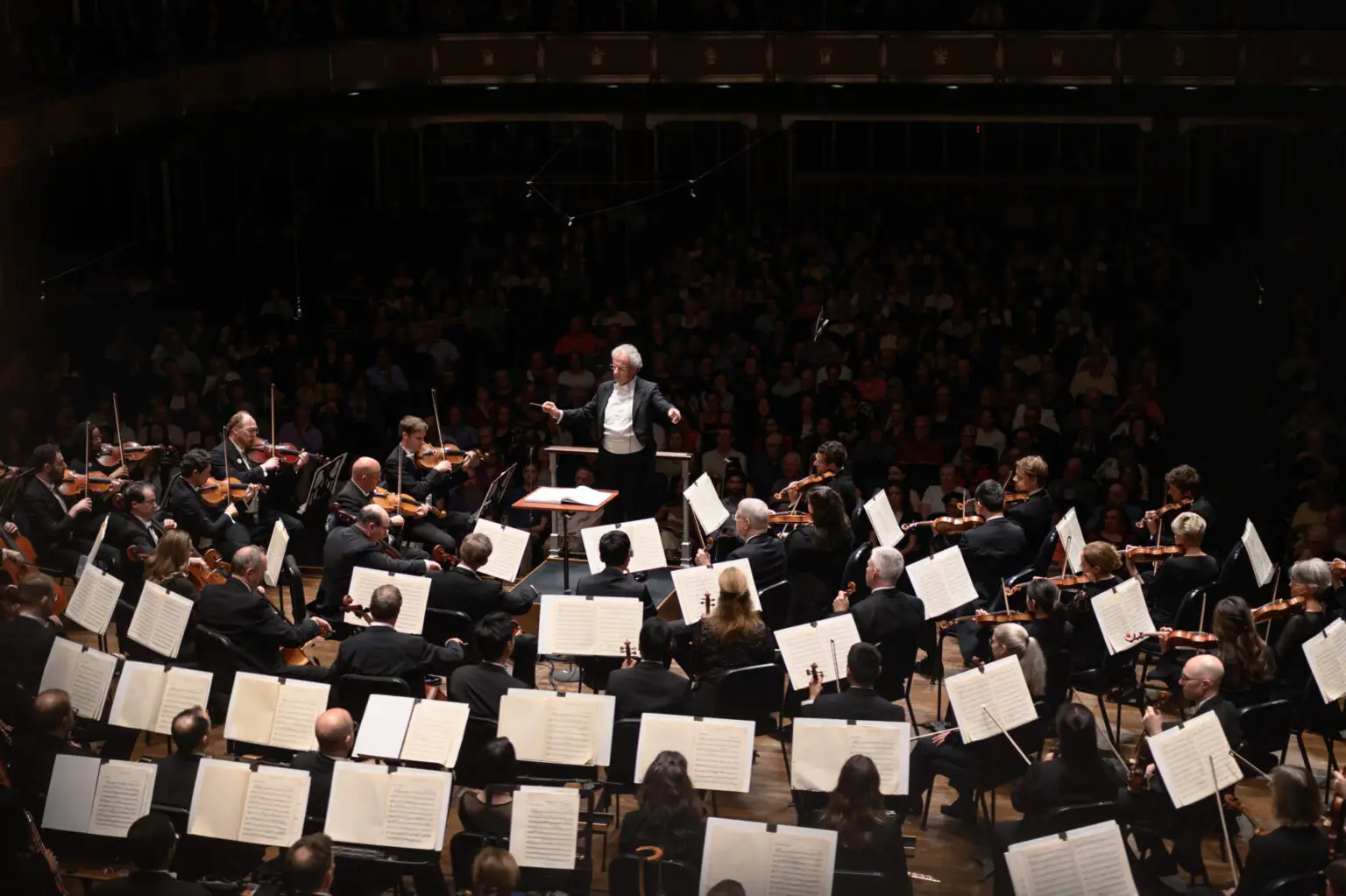
Next year, 2027, Franz Welser-Möst will step down as music director of the American Cleveland Orchestra after 25 (!) years. On October 11, 2026, after a concert with this very orchestra at the Brucknerhaus in Linz, which he is closely connected to in terms of his own musical history, the top conductor was deservedly awarded the Grand Decoration of Honour for Services to the Republic of Austria.
„When I was planning my last major European tour with the Cleveland Orchestra, I wanted to show what this ensemble stands for and highlight its extraordinary qualities,“ said the conductor beforehand. As part of this tour – 15 concerts in 23 days across 9 countries and 12 cities – with his top-notch orchestra, he is also conducting two concerts at the Society of Friends of Music in Vienna as well as one concert at the Vienna Concert Hall.
The Cleveland Orchestra has always been considered the „most European“ of the top American orchestras and is characterized by a very specific sound culture, with pronounced clarity and sometimes a chamber music-like delicacy. Above all, the collaboration with the Austrian music director, who further refined the orchestra’s unique sound, was marked by exceptional artistic standards, which can also be impressively experienced again in the Vienna concerts, both in the Great Musikverein Hall – the series of residencies by Cleveland at this institution, the first of their kind for an American orchestra, marked significant milestones during Welser-Möst’s tenure – and the Great Konzerthaus Hall.
——————————————————————————————
Unclouded joy, light, and brilliance prevail in the main work of the first evening on October 15, 2026, at the Musikverein after the break, with Johannes Brahms‘ Symphony No. 2 in D Major, Op. 73, mostly composed in 1877 during a summer stay of the composer in Pörtschach on Lake Wörther. Fresh and picturesque, like the region itself, this work is brought to life incredibly briskly by Welser-Möst, yet he doesn’t forget its serious, melancholic sides either. One can also interpret this work as predominantly autumn-colored – heard last Sunday at the same venue. With Welser-Möst, however, the mild sun seems to shine continuously, evoking the scents of spring and early summer, so the magnificent piece can unfold all its magic in a different, equally convincing way. The orchestral culture and playing are exquisite; wonderfully drawn cellos in the second movement’s melody, and the phenomenal solo horn also deserves special mention. Extremely delicate, highly subtly, the conductor shapes the work at the podium, focusing on bright clarity and deeply felt lyricism, fully capturing interpretatively the entire richness and immense depth of this beautiful piece. In the finale, a nearly unleashed Welser-Möst lets the orchestra – allow me this comparison – run like noble horses off the reins yet remains in control of the action in every measure. Cheers at the Musikverein after an utterly delightful performance of this symphony, which rightly deserves Brahms’ nickname of the ‚Pastoral‘.
Before the interval, the orchestra shines with a piece by Franz Liszt that begins calm and gentle, builds up at times, and finally ebbs away: his „Orpheus,“ Symphony Poem No. 4. The solos for oboe, violin, and English horn stand out brilliantly in this rarely performed piece. And Symphony No. 2 by Bohuslav Martinu, composed during his American exile and dedicated to his fellow Czechs—a very straightforward, pleasing, forward-driving composition—is also perfectly suited to this orchestra, which is simply brilliant across all sections, especially when Welser-Möst really brings out the eruptions of this work.
The second evening at the Musikverein on October 16, 2026, begins with the introduction and finale from the opera ‚Daphne‘ by Richard Strauss. For his orchestra, Franz Welser-Möst, who has a special affinity for Strauss‘ ‚Greek operas,‘ put together a concert version of certain scenes from this ‚bucolic tragedy.‘ Still, even an especially fine, sensuous performance like this concert cannot replace the vocal parts in the lyrically lavish richness of this work.
——————————————————————————————
After the interval, a very large Cleveland Orchestra takes the stage – just nine double basses are listed – to perform Dmitri Shostakovich’s Symphony No. 8 in C minor, Op. 6, which was composed in the summer of 1943 and premiered in November of the same year by Yevgeny Mravinsky, to whom it is also dedicated. This work, which along with the 7th and 9th Symphonie is counted among the three „war symphonies,“ is not marked by heroism but by a sense of shock at the incomprehensible events of the time, making it a timelessly relevant piece.
Welser-Möst’s interpretation of this massively tragic work is characterized by lyrical flow, structured transparency, and a fine aesthetic, with the conductor and orchestra emphasizing the audibility of the musical architecture in this music, with its complex interweaving, with extreme sensitivity to sound. What Welser-Möst achieves in an incredible way is the creation of a latent, threatening, uncomfortable, even unbearable extreme tension, which he maintains almost relentlessly over the course of a little more than an hour. The orchestra follows him, playing on the edge of their seats, brilliantly arranged across all instrument groups, with stunning solos. The performance creates a profound atmosphere of horror and death, and in the coda of the final movement, the atmosphere at the Musikverein becomes truly chilling.
Impressive how the peculiarities of Shostakovich’s music – this magnificent, shocking work is a cosmos full of irony, sarcasm, fury, depression, melancholy, pain, suffering, and fake euphoria – are brought out. Above all, though, this conductor lets the music speak and doesn’t tend to exaggerate or even radicalize it. The symphonic events are shaped with intense, yet clear power. Certainly, Russian orchestras bring more pathos, drama, and weight to this music – but that doesn’t mean the work can sound more moving or gripping than under Welser-Möst. Standing ovations from the audience followed this powerful performance.
Franz Welser-Möst and Cleveland end their concerts at the Musikverein each with an encore – the first night with the interlude music from the operetta ‚A Night in Venice‘ by Johann Strauss Jr., and the second night with ‚Träumerei‘, by Robert Schumann, arranged for orchestra, by Josef Strauss.
——————————————————————————————
In addition to masterful performances in concert, especially of works by Beethoven, Schubert, Brahms, Bruckner, Tchaikovsky, Mahler, Strauss, Sibelius, Strawinsky, Prokofiev, and Shostakovich, Franz Welser-Möst is also a great supporter of contemporary music. The Austrian composer Bernd Richard Deutsch, born in 1977, was associated with Cleveland as a „fellow composer“ from 2018 to 2020 and dedicated his orchestral work „Intensity,“ composed from 2019 to 2020, to Franz Welser-Möst, who premiered it in 2022 at Severance Hall in Cleveland. Its first performance at the Vienna Concert Hall, following its Austrian premiere last summer at the Bregenz Festival, will now take place in Welser-Möst’s concert with his orchestra on the evening of October 17, 2026 – naturally, this highly appealing work, which is driving forward in the first part, calm in the second, and pulsating again in the third, full of energetic outbursts, is in the best hands with these performers.
To kick things off, there was Symphony No. 34 in C major, KV 338, one of the last major works composed by Wolfgang Amadeus Mozart in Salzburg in 1780. This three-movement, form-specific piece—reminding one of a serenade in the second movement and a concerto in the third—is performed by a large ensemble. At the beginning, the conductor addresses the audience and explains that during the rehearsals for the premiere in Vienna in 1781, Mozart happily wrote to his father that he had 40 violins, 10 double basses, and double woodwinds at his disposal. So, with this performance, Mozart’s intentions should have been fully met.
After the break, Franz Welser-Möst and a highly focused Cleveland Orchestra—always excellently prepared in every section—take on the main work of the evening: Richard Strauss’s „Sinfonia domestica“ in F major, Op. 35, for large orchestra, composed in 1904 and premiered the same year at Carnegie Hall in New York under the composer’s direction. Purely sensual sound, a highly sensual experience, characterizes this fluid, subtle interpretation. The conductor is completely in his element; tight, with virtuoso baton technique, he leads the orchestra with its distinctly fine, equally virtuosic orchestral playing. This wonderful music flows into the hall with immense transparency and balance. Strauss, the master of magical sound, is honored, and the orchestra unfolds its full spectrum of colors. The cheerful, joyfully opulent sonic rush can fully have its effect. Behind the facade of a cozy family idyll, Strauss’ work also hides an artificial masterpiece like no other. The program of a catchy family portrait can even be interpreted as music about music, as a depiction of a composition process. The conductor mixes a healthy dose of melancholy into the lush, rich beauty, making the fine interpretation incredibly moving and touching, giving the piece—unfortunately not heard as often as other tone poems by Strauss—another dimension. Cheers and standing ovations for the conductor and the guests from Cleveland in the Great Hall of the Vienna Concert House.
Gently wistful, the encore also sounds as a farewell from Vienna: the ‚Moonlight Music‘ from the one-act musical conversation piece ‚Capriccio‘ by Richard Strauss.
——————————————————————————————
Franz Welser-Möst, the seventh and, after George Szell, the longest-serving music director in Cleveland, has conducted over 1.200 performances in 26 countries and 15 U.S. states since the start of his tenure in 2002/03; 56 of the currently 100 musician positions were filled by him. Highlights include founding his own record label, launching the streaming platform, Adella.live, and the Mandel Opera & Humanities Festival. Besides his concert activities, he is also a gifted interpreter of his six ‚opera gods‘ – Mozart, Puccini, Verdi, Wagner, Strauss, and Janáček. He will end his work in Cleveland in May 2027, where, in addition to concerts featuring works by Haydn, Mahler, Sibelius, and Stravinsky, three performances of Richard Strauss‘ three-act opera “Die Frau ohne Schatten” are also on the program.